


Caroline McRae’s only child with Dr. Duncan Patterson, daughter Carrie McRae Patterson, was born July 25, 1859 in Mangum. Carrie attended Peace Institute (now William Peace University).
Carrie married attorney Charles Walter Tillett on Feb. 18, 1885, and the couple began their family very soon with the birth of son Duncan Patterson Tillett that November. They remained in Mangum, as Charles practiced law locally until the family settled in Charlotte in 1887.
In time, the young woman from the small Richmond County community would find a comfortable niche among the social leaders in the Queen City, leaving it better than she found it, as it grew into North Carolina’s most populous city within her lifetime.
In his 1955 family history, “Three Prominent Southern Families: Life In The South 100-150 Years Ago,” Charles W. Allison points to Carrie Tillett’s accomplishments over the 1887-1937 span. She assisted in establishing the Charlotte Day Nursery, and for several years served as president of the board of the Alexander Home for Children.
She was a charter member, and regent, of the Liberty Hall Chapter of the Daughters of the American Revolution. Carrie would later serve as the DAR’s state regent, ultimately being named as honorary life regent of the organization.
Author Allison notes other of Carrie Tillett’s involvements: the Charlotte Woman’s Club; the Florence Crittenton Home; and her associations with both the Colonial Dames and the Stonewall Jackson Chapter of the United Daughters of the Confederacy. Carrie was a charter member of the YWCA, where she had oversight of its religious education.
Over 50 years, the Tilletts were associated with both Charlotte First Methodist Church and the Second Presbyterian Church. Carrie served as Sunday school teacher, orphanage committee secretary, and president of a missionary society at Second Presbyterian. She also served as vice president of the Mecklenburg Presbyterian Auxiliary.
Charles and Carrie Tillett sent their four sons off to military service in World War I. All of them returned safely from the war. As a further mark of her patriotism, Carrie volunteered with the Red Cross and its canteen during that time.
Congruent with that time, Carrie helped nurse victims of the Spanish influenza pandemic.
In his later years, Charles W. Allison Sr., a nephew of Carrie Tillett, remembered her as one of four especially influential women in his life. “My aunt, Carrie Patterson Tillett, married my mother’s brother,” he wrote. “I spent a year in her home in my teens, and she played an important part in my life during those formative years. She talked with me for hours and hours drilling into my mind good principles and advising what kind of associates to cultivate.”
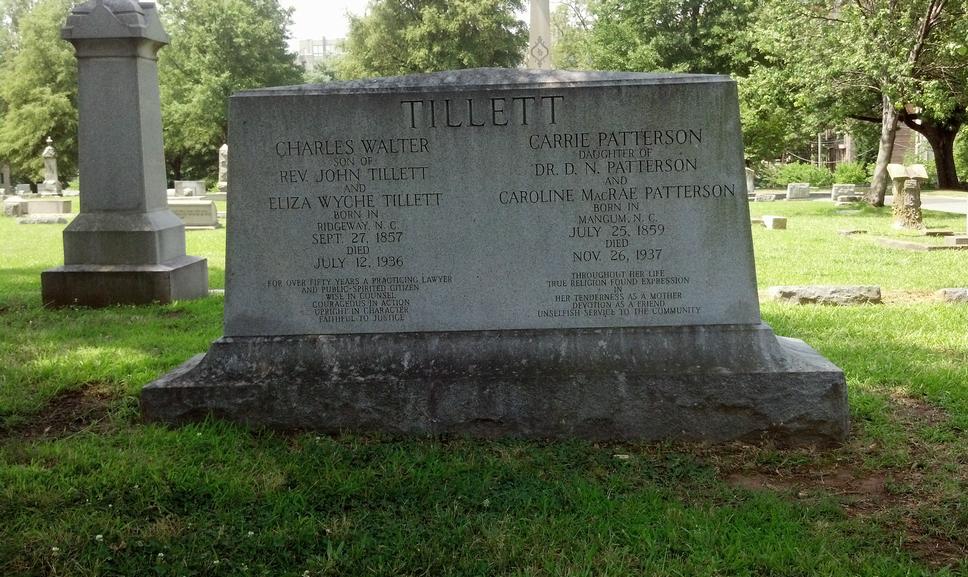
In a similar pattern to that of her father, Dr. Patterson, Carrie Tillett grew ill in the final weeks of her life. Like him, she died at the Tillett home on North Tryon Street, in Charlotte, on Nov. 26, 1937. Following the funeral, Carrie was laid to rest beside her husband of 51 years at Elmwood Cemetery.
Charles Walter Tillett Sr.
While he did not follow his father into the ministry, Charles Walter Tillett Sr., almost certainly inherited his dad’s zeal in his life’s pursuits.
The Rev. John Tillett was an icon among mid-19th century itinerant Methodist ministers in North Carolina, especially noted for strong pro-temperance views at a time when the movement was ushering the country to Prohibition by 1920.
Excelling at Virginia’s Randolph-Macon College, Charles won the school’s prestigious Southern medal for debating and oratory before graduating with the class of 1880. In the early 1880s, Tillett taught school in Wilmington, and here in Rockingham, where he also served as superintendent of Richmond County schools in 1883.
Charles Tillett made a further impact locally before heading off to larger pastures. In 1884 he was selected as chairman of the county’s Democratic party; and was elected to a term as mayor of Rockingham during that time.
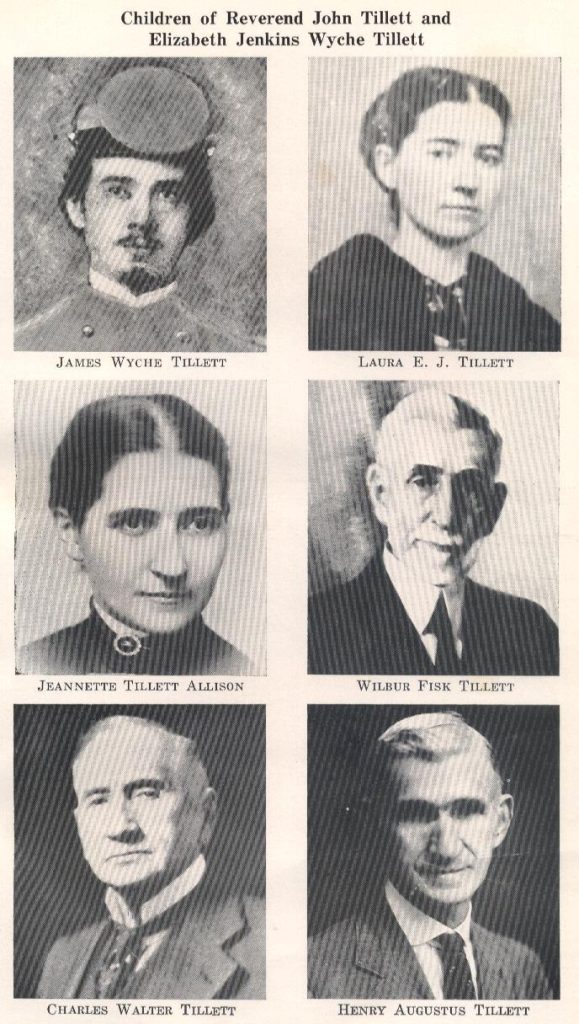
The practice of law was Charles Tillett’s professional love. Upon his admission to the bar in 1882, he entered legal practice in Rockingham with Platt D. Walker, who went on to serve as state legislator, and judge, before his election to the state’s highest court.
After settling in Charlotte with his wife, Carrie, in 1887, Tillett built a successful law practice there. His first law partner in the Queen City was Col. Hamilton C. Jones, who had amassed an impressive record of Civil War battle leadership with North Carolina regiments prior to his achievements in both the law and in politics.
At age 37, and a resident of Charlotte for seven years, Charles Tillett came to oratorical prominence at the funeral of former governor Zebulon B. Vance, a landmark Tar Heel event near the end of the 19th century. A century and a third later, it is difficult for citizens to fully appreciate the impact of Zebulon Vance. A quick capsule of his life, and passing, sheds some understanding of Vance, while providing an early glimpse of Caroline McRae Patterson’s promising young son-in-law.
A Buncombe County native, Vance served in the state legislature, and in the U.S. House, during pre-Civil War days. Following the war’s outbreak, Col. Vance commanded the 26th North Carolina Infantry Regiment (in the chain of command over Caroline Patterson’s brother, Stokes McRae). In 1862, he was elected as governor of North Carolina, serving until after the war’s end.
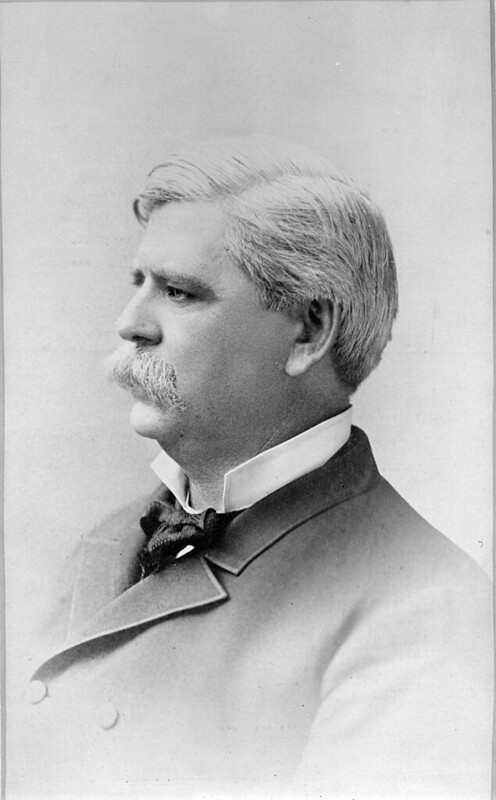
Vance served as governor, again, near the end of Reconstruction from 1877 until 1879. For the 15 years preceding his 1894 death, Vance served as U.S. Senator.
While some of his views are considered controversial here in the 21st century, Vance was beloved by Tar Heel citizens during his time for his leadership during the Civil War, and in modernizing the state’s economy afterward; for his speech-making and humor; and, for his outreach to the Jewish community.
Upon his passing, Vance’s remains lay in repose inside the U.S. Senate chamber. A funeral observance drew not only members of Congress, but President Grover Cleveland, the vice president, most members of the president’s cabinet, and nearly every U.S. Supreme Court justice.
Vance had won wide respect beyond the state and, evidently, reconciled with former enemies as an impressive host of dignitaries accompanied his body to Raleigh for further services. Among them were congressmen and senators of both major parties, northerners, and at least two former Union Army officers — one of them a Medal of Honor recipient.
Although he was transported by train to Asheville for final services, two memorials for Vance were held in Charlotte, on April 16 and 18, in order to accommodate public demand. If ever there was a moment for Tillett’s rhetorical abilities to shine, the April 18 memorial was it.
Former Charlotte mayor Clement Dowd described the moment in his 1897 biography of Vance.
“The gem of all the talks was reserved for the last — that of Mr. C.W. Tillett.” “[T]he people sat rapt,” Dowd observed.
Tillett’s words soared in the approximate 700-word oration as he captured the grief and remembrances of most North Carolinians. Employing the recurring theme, “Zeb Vance is dead!” he lauded the senator and former governor:
“In war and in peace, the one of all her sons to whom his mother state looked most for succor and relief …
“When his native state was plunged in throes of civil strife, he went forth … to defend and save her and fought with valor all her foes; how called to rule as chief executive in times that tried men’s souls, he ruled so wisely and so well …”
So successful had Charles Tillett grown by the dawning years of the 20th century, a 1906 book, “Prominent People of North Carolina,” accorded him a lengthy section among the state’s leading professional, business and public men. Tillett drew high praise in the publication’s sketch of him:
“[Tillett] prepares every case with the utmost care before going into court, presenting all the facts … with remarkable lucidity.
“[H]e has a direct forcible delivery that carries conviction.”
Well into his 40s by that time, Tillett’s practice was so lucrative that he opted to eschew either elective or appointive office. He had argued before the United States Supreme Court (and would do so again), and had declined an appointment by Gov. C.B. Aycock (1901-05) to a superior court judgeship.
Despite his reluctance, Tillett was never far from the minds of Tar Heel political kingmakers, as illustrated in July 1911 Charlotte Observer items anticipating the 1912 gubernatorial campaign:
“But we shall know more when [Lt. Governor William] Newland and [C.W.] Tillett come into the field. If they come there will be a contest — never fear. They are first class fighting men.
“This situation is reviving the talk of C.W. Tillett of Charlotte getting into the race for governor, although he has [rebuffed it].”
It might have amused Caroline Patterson that while her son-in-law remained off the state’s ballots, he maintained his visibility with its powerful.
In a July 1911 Observer item, Tillett stated that “he is a friend of all four of [N.C.’s] candidates for the [U.S.] Senate.” The same item noted that Tillett was in Raleigh that day (July 26) to call on then-Governor William Kitchin, then went on an automobile ride with former Governor C.B. Aycock.
Tillett’s strengths seemed to lie in his abilities behind the scenes. His efforts and influence at the Democrats’ 1908 state convention in Charlotte are credited in helping William W. Kitchin secure the nomination for governor, which he won that November.
It comes as little surprise that Tillett was elected president of the N.C. Bar Association for the 1910-11 term, and he chose to highlight a long-standing problem of jurisprudence.
Addressing denied, or delayed, justice under law is traceable to 1215 and the Magna Carta. Among the document’s principles is found, “[T]o no one will we deny or delay right or justice.” The concept was still a work in progress by the 1860s when British Prime Minister William Gladstone observed, “Justice delayed is justice denied.”
Tillett considered the matter urgent enough as he devoted his parting address to the problem in 1911. The Charlotte Observer published the 10,000-word speech over two issues of the newspaper.
In his late 60s, Charles Tillett was likely unaware of the impression he was making on one adolescent boy at a criminal trial in the mid-1920s.
The youth, Charlie Rhyne, later described his experience sitting in the public gallery and watching Tillett in action defending a wife accused of killing her husband:
“A man who was a member of one of the big families of the county had his throat slit from ear-to-ear by his wife, [who was] an outsider. The attorney who defended her was an old string-tie lawyer named C.W. Tillett.”
In the May 5, 1958 issue of Time magazine, Rhyne described Tillett’s “flamboyant arguments” as he won an acquittal for his client. “The fact that this girl got justice in a place where people didn’t like her made a tremendous impression on me.”
A Tar Heel native who grew up near Charlotte, Charlie Rhyne was featured in Time as that year’s president of the American Bar Association.
At age 70, the old “string-tie lawyer” made a foray into the national political arena in defense of the anticipated Democratic candidate for president as the 1928 election season was heating up.
It is difficult for those of us in more enlightened times to grasp a bias against Catholics holding public office. Indeed, a Catholic would not win election to the presidency until 1960.
It is difficult, further, for us to imagine a public arena in our country in which the manufacture, sale, or transport of alcoholic beverages could be outlawed with Constitutional backing.
Those were the realities of the American political scene of the 1920s, particularly in the South. It must have required more than a dollop of courage for Charles Tillett Sr., to wade in against these firmly-held beliefs.
In November 1927, Tillett published a lengthy article in defense of New York governor Al Smith, who was seeking the Democratic nomination for president. Smith was Catholic, and a proponent of a constitutional amendment to negate the document’s 18th amendment permitting legislation to outlaw the manufacture and sale of alcohol. So impressed was Smith and his advisers with Tillett’s effort, the 70-year old Charlottean was asked to expand on it, and the piece was published in booklet form under the title “Al Smith and Fair Play” and distributed nationwide.
No stranger to public controversy, Tillett had published newspaper columns in the 1920s promoting intellectual freedom and the separation of church and state. Calling himself a “near-iconoclast,” he would attack the use of religious doctrine, or belief, to suppress independent thought.
Tillett was forthcoming in admitting his differences with Governor Smith, i.e., his unabashed identity as a Methodist vs. Smith’s Roman Catholicism; and, his support of Prohibition (a “dry”) as opposed to Smith’s “wet” anti-Prohibition stance. But Tillett was even more firm in his call for “fair play” toward the governor in the campaign.
As the presidential campaign neared its climax in late October, 1928, Charles Tillett was jousting in the press over Al Smith with one of the South’s most powerful religious leaders, Bishop Edwin Mouzon of the Methodist Episcopal Church, who had oversight of churches and conferences from Texas to the Carolinas.
Essentially, Tillett and Mouzon charged each other with attempting to intimidate ministers over support of presidential candidates. Months earlier, Bishop Mouzon joined other bishops in a statement describing the Democratic candidate as “an outstanding enemy of national prohibition …”
Mouzon further agreed with a 1926 declaration, “That in our state … officials must be selected who believe in enforcement, not only because prohibition is the law, but because it ought to be the law (italics added) and all our people … are called upon to exert their full influence as Christians and as patriotic citizens of the republic.”
In his October 1928 article, according to The Charlotte News, Tillett exhorted Mouzon to “Repeat the charge you made against me in conference, and make good your charge.” Or else, “confess before God and man that you have wronged me … and publicly retract it.”
It was apparent that Tillett’s abilities in turning a phrase, at age 37, to paean the life of Zebulon Vance, had not dimmed when employed in defense of a controversial northern governor over three decades later.
His sense of humor was well-intact at age 70, as well. His mother-in-law, Caroline Patterson, would surely have admired his grace in the face of political loss, and may have allowed a smile at something Charles did at campaign’s end.
As well as losing North Carolina and Mecklenburg County, Charles Tillett’s candidate succumbed to the nationwide Herbert Hoover landslide by an 18-point popular margin. Opinion polling was rudimentary then, but the Smith campaign — and Tillett — must have known what was coming.
On election eve, Nov. 5, 1928, Charles Tillett penned a lengthy ad in the Charlotte Observer, allowing his wit and humor to shine in a notice for a “Monster Democratic Rally” that evening at Charlotte’s City Auditorium.
“If you miss the entertainment prepared for you tonight, you will be asking someone to kick you tomorrow morning …”, he began as he went on to tease about the event, and about impersonators who would lampoon the bishops with whom he had battled, promising “a riot from start to finish.”
“Don’t be afraid of tear gas in the auditorium tonight. Commissioner R.L. Brown has assured the committee that he will rid the auditorium of the gas, or he will resign without waiting for a recall.
“I have had … experience in meetings of this precise kind and I can assure the public that … this meeting will be the most entertaining political gathering ever held in Charlotte. Don’t be afraid that the speeches will … become tiresome and boring. I will preside over the meeting. I know how to control the situation. I will use every means short of killing a speaker in order to protect the audience against a lengthy, boring speech. Trust me.”
Charles W. Tillett Sr., was the dean of the Charlotte area bar at his death on July 12, 1936, in Charlotte, at age 78. He is buried next to his wife, Carrie, in Elmwood Cemetery.
NOTE: This story was previously published at RichmondObserver.com.